
Sitemap
A list of all the posts and pages found on the site. For you robots out there is an XML version available for digesting as well.
Pages
Posts
Future Blog Post
Published:
This post will show up by default. To disable scheduling of future posts, edit config.yml and set future: false.
Blog Post number 4
Published:
This is a sample blog post. Lorem ipsum I can’t remember the rest of lorem ipsum and don’t have an internet connection right now. Testing testing testing this blog post. Blog posts are cool.
Blog Post number 3
Published:
This is a sample blog post. Lorem ipsum I can’t remember the rest of lorem ipsum and don’t have an internet connection right now. Testing testing testing this blog post. Blog posts are cool.
Blog Post number 2
Published:
This is a sample blog post. Lorem ipsum I can’t remember the rest of lorem ipsum and don’t have an internet connection right now. Testing testing testing this blog post. Blog posts are cool.
Blog Post number 1
Published:
This is a sample blog post. Lorem ipsum I can’t remember the rest of lorem ipsum and don’t have an internet connection right now. Testing testing testing this blog post. Blog posts are cool.
portfolio
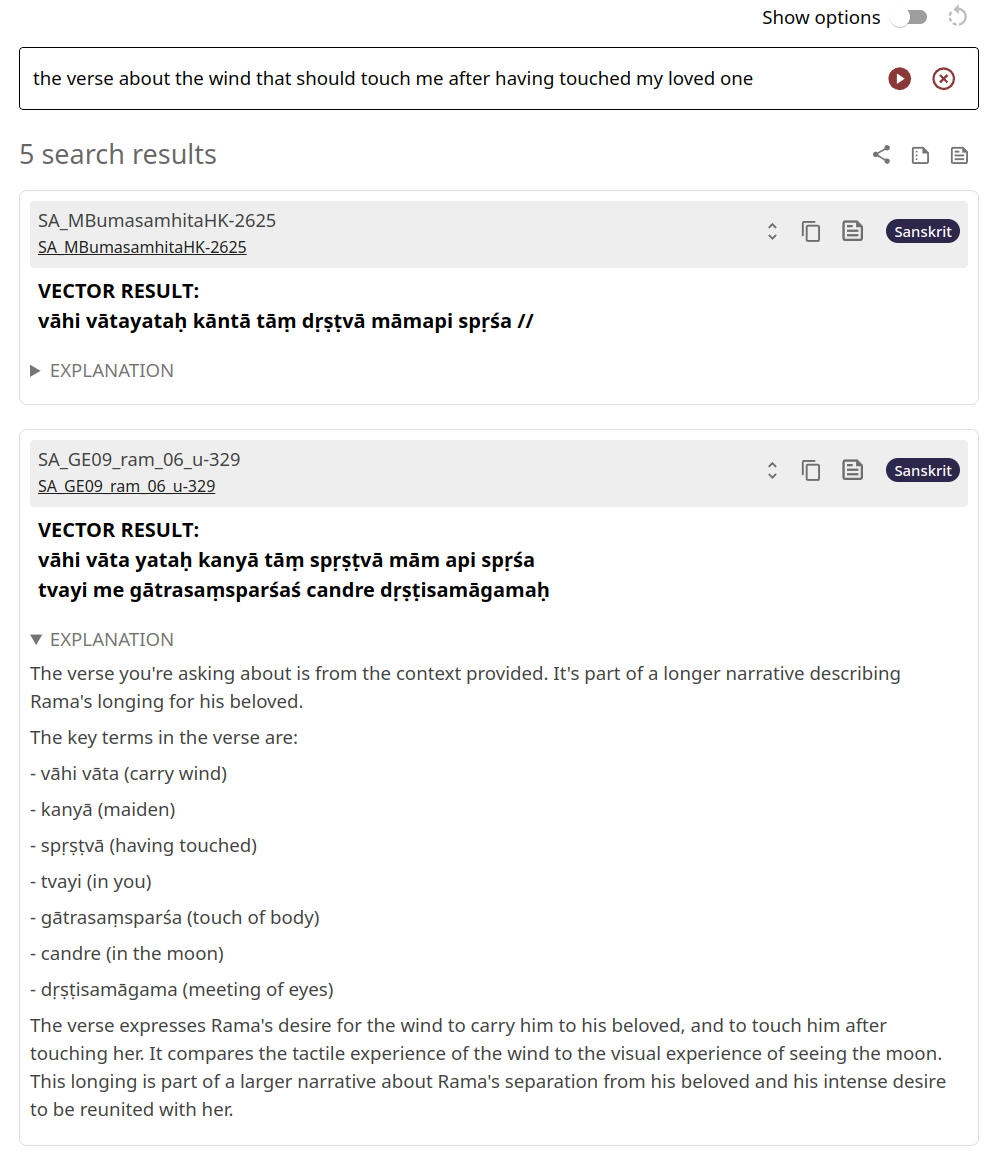
Dharmamitra.org AI application for classical Asian Languages
Dharmamitra is a website that provides state-of-the-art machine translation and semantic search functionality for the classical Asian languages Sanskrit, Pali, Tibetan, and Chinese.
Portfolio item number 2
Short description of portfolio item number 2 
publications
Sanskrit Word Segmentation Using Character-level Recurrent and Convolutional Neural Networks
Published in Conference on Empirical Methods in Natural Language Processing, 2018
This paper presents end-to-end neural network models for Sanskrit tokenization, jointly handling compound splitting and Sandhi resolution. The language-agnostic models outperform previous approaches for Sanskrit and also excel in German compound splitting.
Recommended citation: Hellwig, O., & Nehrdich, S. (2018). "Sanskrit Word Segmentation Using Character-level Recurrent and Convolutional Neural Networks." In Proceedings of the Conference on Empirical Methods in Natural Language Processing (EMNLP).
Download Paper
A Method for the Calculation of Parallel Passages for Buddhist Chinese Sources Based on Million-scale Nearest Neighbor Search
Published in Journal of the Japanese Association for Digital Humanities, 2020
This paper introduces a novel approach to detect parallel passages in the Chinese Buddhist canon using continuous word representations and nearest neighbor search. It evaluates the quality of detected parallels and demonstrates a web application for philological research.
Recommended citation: Nehrdich, S. (2020). "A Method for the Calculation of Parallel Passages for Buddhist Chinese Sources Based on Million-scale Nearest Neighbor Search." Journal of the Japanese Association for Digital Humanities, 5(2), 132-153.
Download Paper
Obtaining More Expressive Corpus Distributions for Standardized Ancient Languages
Published in CHR 2021: Computational Humanities Research Conference, 2021
This paper introduces a latent variable model for ancient languages to quantify the influence of early authoritative works on their literary successors in terms of lexis. The model jointly estimates word reuse and composition dates, applied to a corpus of pre-Renaissance Latin texts.
Recommended citation: Hellwig, O., Sellmer, S., & Nehrdich, S. (2021). "Obtaining More Expressive Corpus Distributions for Standardized Ancient Languages." In Proceedings of the Computational Humanities Research Conference (CHR 2021), Amsterdam, The Netherlands.
Download Paper
Accurate Dependency Parsing and Tagging of Latin
Published in Proceedings of the Second Workshop on Language Technologies for Historical and Ancient Languages, 2022
This paper explores the use of Latin BERT word embeddings for morpho-syntactic tagging and introduces a graph-based dependency parser for Latin. The proposed models show competitive performance in tagging and outperform various baselines in parsing.
Recommended citation: Nehrdich, S., & Hellwig, O. (2022). "Accurate Dependency Parsing and Tagging of Latin." In Proceedings of the Second Workshop on Language Technologies for Historical and Ancient Languages, pages 20-25, Marseille, France. European Language Resources Association.
Download Paper
SansTib, a Sanskrit - Tibetan Parallel Corpus and Bilingual Sentence Embedding Model
Published in Proceedings of the Thirteenth Language Resources and Evaluation Conference, 2022
This paper introduces SansTib, a large-scale Sanskrit-Classical Tibetan parallel corpus with 317,289 automatically aligned sentence pairs. It also presents a bilingual sentence embedding model and evaluates the quality of the automatic alignment using a gold evaluation dataset.
Recommended citation: Nehrdich, S. (2022). "SansTib, a Sanskrit - Tibetan Parallel Corpus and Bilingual Sentence Embedding Model." In Proceedings of the Thirteenth Language Resources and Evaluation Conference, pages 6728-6734, Marseille, France. European Language Resources Association.
Download Paper
Data-driven dependency parsing of Vedic Sanskrit
Published in Language Resources and Evaluation, 2023
This paper introduces the first data-driven parser for Vedic Sanskrit, exploring various input feature representations and analyzing parsing errors. The optimal model achieves 87.61 unlabeled and 81.84 labeled attachment scores, demonstrating good performance for this under-resourced ancient Indo-Aryan language.
Recommended citation: Hellwig, O., Nehrdich, S., & Sellmer, S. (2023). "Data-driven dependency parsing of Vedic Sanskrit." Language Resources and Evaluation, 57, 1173-1206.
Download Paper
MITRA-zh: An efficient, open machine translation solution for Buddhist Chinese
Published in NLP4DH, 2023
This paper presents a novel dataset and fine-tuned models for machine translation of Buddhist Classical Chinese, outperforming commercial solutions in efficiency and performance.
Recommended citation: Nehrdich, S., Bingenheimer, M., Brody, J., & Keutzer, K. (2023). "MITRA-zh: An efficient, open machine translation solution for Buddhist Chinese." NLP4DH.
Download Paper
Observations on the Intertextuality of Selected Abhidharma Texts Preserved in Chinese Translation
Published in Religions, 2023
This study applies computer-aided methods to detect textual reuse in Xuanzang’s translation corpus and selected Abhidharma texts in Chinese. It presents network graph visualizations and examines reuse patterns, demonstrating alignment with established scholarship and providing a foundation for future detailed studies.
Recommended citation: Nehrdich, S. (2023). "Observations on the Intertextuality of Selected Abhidharma Texts Preserved in Chinese Translation." Religions, 14(7), 911.
Download Paper
One Model is All You Need: ByT5-Sanskrit, a Unified Model for Sanskrit NLP Tasks
Published in The 2024 Conference on Empirical Methods in Natural Language Processing (Findings), 2024
This paper introduces ByT5-Sanskrit, a new pretrained language model for Sanskrit NLP tasks, demonstrating superior performance in word segmentation, dependency parsing, and OCR post-correction, while also introducing a novel multitask dataset.
Recommended citation: Nehrdich, S., Hellwig, O., & Keutzer, K. (2024). "One Model is All You Need: ByT5-Sanskrit, a Unified Model for Sanskrit NLP Tasks." In Proceedings of the 2024 Conference on Empirical Methods in Natural Language Processing (Findings).
Download Paper
Breakthroughs in Tibetan NLP & Digital Humanities
Published in Revue d'Etudes Tibétaines, 2024
This paper discusses recent advancements in Tibetan Natural Language Processing and Digital Humanities.
Recommended citation: Meelen, M., Nehrdich, S., & Keutzer, K. (2024). "Breakthroughs in Tibetan NLP & Digital Humanities." Revue d'Etudes Tibétaines. 72, 5-25.
Download Paper
Sanskrit Word Sense Disambiguation Based on Lexicographic Definitions
Published in Proceedings of the 8th International Sanskrit Computational Linguistics Symposium (ISCLS), 2026
A word sense disambiguation system for Vedic and Classical Sanskrit that extends the gloss reader architecture of Blevins and Zettlemoyer (2020), trained on the Monier-Williams Sanskrit-English dictionary. The paper studies how semantic inventory choice affects WSD accuracy and identifies alignment-based and LLM-based augmentation as promising strategies for increasing coverage of underrepresented senses.
Recommended citation: Hellwig, O., Sellmer, S., Nehrdich, S., Widmer, P., & Sennrich, R. (2026). "Sanskrit Word Sense Disambiguation Based on Lexicographic Definitions." In Proceedings of the 8th International Sanskrit Computational Linguistics Symposium, IIT Roorkee, India.
Download Paper
talks
Multilingual Semantic Mining for Text Alignment and Parallel Corpus Building for Buddhist Languages
Published:
MITRA: Developing Natural Language Processing Tools for the Languages of Buddhist Literature
Published:
Massive Multilingual Machine Translation and Search for Buddhist Languages: The Mitra Project
Published:
MITRA: Developing Language Models for Machine Translation and Search in Buddhist Source Languages
Published:
Translation and search are among the fundamental problems when researching the textual source material of Buddhist traditions. MITRA has successfully developed machine translation models to ease the access to this material. When it comes to search, The Dharmamitra project approaches this problem by using semantic embeddings that enable search on related passages in different languages, regardless of whether the answer to the query is found in a text preserved in Pāli, Sanskrit, Tibetan, or Chinese. In addition to providing researchers with this powerful search system, Dharmamitra also provides a system for the automatic detection of similar text passages within the same language and across different languages. In my talk, I will demonstrate how these tools are designed and how researchers can access them and integrate them in their workflow.
MITRA: Beyond Just Machine Translation for Premodern Asian Low Resource Languages
Published:
Recent years saw the rise of multilingual language models that achieve high levels of performance for a large number of tasks, with some of them handling hundreds of languages at once. Premodern languages are usually underrepresented in such models, leading to poor performance in downstream applications. The Dharmamitra project aims to develop a diverse set of language models to address these shortcomings for the classical Asian low-resource languages Sanskrit, Tibetan, Classical Chinese, and Pali. These models provide solutions for low-level NLP tasks such as word segmentation and morpho-syntactic tagging, as well as high-level tasks including semantic search, machine translation, and general chatbot interaction. The talk will address the individual challenges and unique characteristics of the data involved, and the strategies deployed to address these. It will also demonstrate how these different tools can be combined in an application that goes beyond simple sentence-to-sentence machine translation, providing detailed grammatical explanations and corpus-wide search to support both early-stage language learners and experienced researchers with specific demands.
Dharmamitra
Published:
Dharmamitra: Developing a Toolkit for Philological Work on Premodern Asian Low-Resource Languages
Published:
This talk was presented as part of the workshop “Case studies from current research projects - Conversations on Digital Scholarly Editing” organized by Martina Dello Buono and Florinda De Simini at L’Orientale University of Naples.
MITRA Search: Exploring Buddhist Literature Preserved in Classical Asian Languages with Multilingual Approximate Search
Published:
Part of the International Symposium “Buddhist Studies and Digital Humanities: 100 Years of the Taishō Tripiṭaka and 30 Years of SAT”
MITRASearch: Building Information Retrieval Systems for Classical Asian Languages in the Age of AI
Published:
Recent advances in artificial intelligence and natural language processing have revolutionized information retrieval and question-answering systems. This talk introduces MITRASearch, a specialized search platform designed for exploring Buddhist literature preserved across Classical Asian languages including Chinese, Tibetan, Sanskrit, and Pāli. The system leverages multilingual approximate search capabilities to enable scholars to identify parallel passages and conduct comparative analyses across different writing systems and translations. We demonstrate how large language models integrated into the Dharmamitra project enhance user interaction with search results, facilitating dynamic exploration of these classical texts. This innovation addresses the long-standing challenge of cross-linguistic textual research in Buddhist studies and offers new possibilities for digital humanities scholarship.
Machine Translation for Asian Studies
Published:
With the advent of large language models, machine translation (MT) has become a widely used, but little understood, tool for research, language learning, and communication. GPT, Claude, and many other model series allow researchers now to access literature in different languages, and even translate primary texts composed in classical languages with few resources available. But how to evaluate the translation output of such machines? How to decide which model is the best for my own research purposes and how to tweak it? How will MT impact language learning, which is fundamental for Asian Studies?
From Sthiramati to Dharmamitra: Developing Digital Tools for a New Age of Philological Buddhist Studies
Published:
This presentation was part of a workshop at Keio University, co-organized by Kakenhi Special Promotion Research “Compilation of the Reiwa Daizokyo as a Digital Research Infrastructure - Presentation of a Research Infrastructure Construction Model for Next-Generation Humanities (JP25H00001)” and the Research Infrastructure Hub, Research and Development Project for the DX of Humanities and Social Sciences.
Is training deep neural embeddings worth the effort? A preliminary investigation of different representation methods for semantic similarity tasks in Buddhist Chinese and related languages of the Buddhist tradition
Published:
This presentation is part of an online workshop on digital approaches to intertextuality in pre-modern East Asian texts. The talk will provide a preliminary investigation of different representation methods for semantic similarity tasks in Buddhist Chinese and related languages of the Buddhist tradition.
MITA: New Research Tools for a Paradigm Shift in the Philological Study of Buddhist Texts Based on Machine Translation Technology
Published:
I presented as part of a panel with Marcus Bingenheimer at the IABS Conference, introducing the MITA toolkit and discussing how machine translation technology is enabling a paradigm shift in the philological study of Buddhist texts.
Dharmamitra & DharmaNexus: A New Set of Digital Tools for the Philological Study of Buddhist Texts
Published:
Traditional philological work on Buddhist sources often consists of laborious keyword searches across disparate corpora in multiple languages, followed by manual collation of parallels, a workflow that favours stamina over insight. Dharmamitra is an open-source platform that collapses those tasks to seconds using advanced computational and deep learning methods.
Dharmamitra and DharmaNexus: Digital Tools for the Philological Study of Buddhist Texts
Published:
I presented on Dharmamitra and DharmaNexus at National Taiwan University, introducing the platforms’ machine translation, semantic retrieval, and intertextuality discovery capabilities for Buddhist texts in Sanskrit, Pāli, Tibetan, and Chinese.
Machine Learning and Large Language Models in Buddhist Studies: The Dharmamitra Project
Published:
Recent advances in machine learning, particularly the advent of Large Language Models (LLMs) such as ChatGPT, are rapidly shaping new ways of accessing and interpreting knowledge preserved in textual form. This has far-reaching implications for the study of the Buddhist textual tradition. Applications once considered decades away, such as the fluent machine translation of Classical Tibetan or Chinese into English, are now commonly used by scholars at all levels, from early-career students to senior researchers. This talk will provide an overview of the tools that the Dharmamitra project currently offers the Buddhist Studies community, with a focus on machine translation and cross-lingual search for philological use cases. It will also introduce the underlying technical architecture of these tools and discuss both the capabilities and limitations of the current generation of language models for philological applications.
Building the Foundations of Buddhist Philology through Digital Humanities: Exploring the Potential of the Tohoku University Digital Archives (ToUDA)
Published:
I presented as part of the Digital Archive Research Unit at the Center for Integrated Japanese Studies (CIJS) at Tohoku University. The workshop and symposium was co-hosted by CIJS, the Tohoku University Digital Archives Steering Committee, and the Tohoku University Library. I delivered a lecture and participated in a panel discussion on the digitization of academic resources in Tohoku University and new developments in Buddhist textual studies with AI technology.
Dharmamitra: A Platform that Makes Translation and Discovery of Buddhist Texts Possible Across Language Barriers
Published:
I presented on the Dharmamitra platform as part of the panel “AI in the Fo Guang Dictionary of Buddhism English Translation Project and MITRA.” The panel showcased how emerging AI tools support large-scale Buddhist translation and lexicographical research. I introduced Dharmamitra as a collaborative AI-driven platform developed by Tohoku University with the Tsadra Foundation and Berkeley AI Research Lab, which employs Large Language Models for high-quality machine translation of Sanskrit, Pali, Tibetan, and Chinese alongside vector-based semantic retrieval.
Translation, OCR, and Semantic Retrieval: Current Status and Future Outlook of the Dharmamitra Ecosystem
Published:
I presented on the current status and future outlook of the Dharmamitra ecosystem, covering translation, OCR, and semantic retrieval capabilities for Buddhist texts. The symposium was held at Tokyo International Forum Hall D5 and focused on “The Significance of Humanities and Research Infrastructure Development in the DX-AI Era.”
AI and Indological/Buddhological Researches: Dharmamitra/DharmaNexus and Its Application
Published:
I co-presented with Kengo Harimoto (University of Naples “L’Orientale”) at the 32nd Annual Conference of the Association for the Study of the History of Indian Thought. The talk introduced Dharmamitra and DharmaNexus and discussed their application in Indological and Buddhological research. The event was held in a hybrid face-to-face and online format.
Dharmamitra: A Data-Driven Platform for the Research of Buddhist Texts in Multiple Languages Using Advanced NLP Methods
Published:
I presented at the 30th Information and Knowledge Science Forum at the Doshisha University Osaka Satellite Campus. The talk introduced Dharmamitra as a data-driven platform for studying Buddhist texts across multiple languages using advanced NLP methods.
Is This the End of (Buddhist) Philology as We Know It? If So, What’s Next?
Published:
I delivered a hybrid lecture at the International Institute for Asian Studies at Leiden University. With rapidly growing digital collections and increasingly powerful AI and information-retrieval tools, textual Buddhist Studies is undergoing a paradigm shift. The talk reflected on what this shift means for the future of the field and the role of philological scholarship in an age of generative AI.
DharmaNexus as a Multilingual Graph of Buddhist Intertextuality: Design Choices, Research Uses, and Future Applications
Published:
I gave a guest lecture at the Ghent Centre for Buddhist Studies on the invitation of Charles DiSimone, as part of the Gandhāra Corpora Lecture Series and the Spring 2026 Permanent Training in Buddhist Studies. The talk examined DharmaNexus as a database tracking intertextual relationships between passages across languages and sources, discussed key design choices and how intertextual relationships are determined and represented, demonstrated research applications for discovering parallels in Buddhist texts, and addressed limitations of AI-assisted multilingual systems in this context.
Dharmamitra: A Platform to Support Research across Language Boundaries on Buddhist Textual Material
Published:
I gave this lecture at Ghent University as part of the two-day workshop “Japanese Studies in Japan and Belgium” (March 19–20, 2026), hosted by the Center for Integrated Japanese Studies (CIJS) at Tohoku University and co-organized with the Ghent University Institute for Japanese Studies. The talk introduced Dharmamitra as a platform supporting research across language boundaries on Buddhist textual material.
OCR and Beyond: Philology and Digital Archives in the Age of AI
Published:
I co-organized this international workshop with Prof. Ryuta Kikuya at the Center for Integrated Japanese Studies (CIJS) at Tohoku University, focusing on philology and digital archives in the age of AI. The workshop covered computer-aided annotation workflows, Sanskrit studies utilizing generative AI, and the digitization of Tibetan, Nepalese, and Japanese Esoteric Buddhist texts.
Access as Nonviolence: Designing DH Platforms That Reduce Inequality
Published:
I gave this talk as part of the Ahiṃsā Lecture Series, a Hamburg–Kyoto blended-learning partnership exploring nonviolence as a globally relevant ethical framework. We are living in an age where an ever-increasing amount of digitally available data and rapidly advancing AI tools are fundamentally changing the way research on textual material of Asian traditions is undertaken. This fundamental transition holds clear dangers: AI systems are, in many respects, systems that amplify existing trends and patterns in the data they are trained on, and the profit-oriented nature of the companies behind the most popular applications raises serious questions about their trustworthiness when it comes to adequate knowledge representation. In this talk I examined how Digital Humanities and AI can function as a bridge to reduce bias and inequality, and how crucial the development of independent, transparent systems with openly accessible datasets is for ensuring a positive impact of these technologies on scholarship. Framing nonviolence (ahiṃsā) as a practical concern for research infrastructures, I argued that “doing less harm” in this context means building tools that broaden access while making their assumptions, sources, and limitations visible.
Artificial Intelligence in Buddhist Studies
Published:
I led a workshop in Leipzig focused on the use of artificial intelligence in Buddhist Studies, with particular emphasis on the research tool Dharmamitra and its application to philological work on Buddhist textual material.
Dharmamitra in 2026: Current Capabilities and Future Developments
Published:
I gave a presentation on the current capabilities and future developments of Dharmamitra at Ludwig-Maximilians-Universität München. The event also included a hands-on workshop titled “Accelerated Sanskrit Textual Scholarship in the Age of Agentic AI,” led by Kengo Harimoto (University of Naples “L’Orientale”).
teaching
Teaching experience 1
Undergraduate course, University 1, Department, 2014
This is a description of a teaching experience. You can use markdown like any other post.
Teaching experience 2
Workshop, University 1, Department, 2015
This is a description of a teaching experience. You can use markdown like any other post.